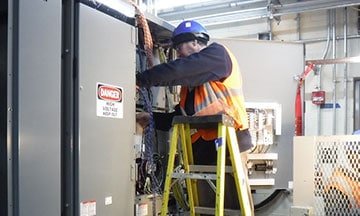

Design, Maintenance of High, Medium and Low Voltage Switchgears (HV, MV & LV)
 Print
Print Download pdf
 Download Brochure
 Register
Book Classes Now

Course Overview
The design and maintenance of switchgear play an important role in the supply and control of electrical power in a utility distribution system.
It must be understood that there is an incredible variety of equipment used on low, medium and high voltage switchgear today and careless maintenance practices can lead to power system inefficiency and loss of system reliability.
Therefore, this course is designed to inform participants of the latest development of circuit breakers and present the common and modern-day aspects of low, medium and high voltage switchgear design and maintenance.
What themes will be covered in this “Design, Maintenance of High, Medium and Low Voltage Switchgear” course? The focus of this program will discuss fundamentals of circuit breakers, types of low and medium voltage circuit breaker, HV, switchgear, insulation and maintenance of CB, over current trip equipment, and the testing of low and medium CB.
This Zoe training course will empower you with knowledge in the transient phenomena of power systems and the methods of system earthing and protection requirements.
Course Objectives
Upon completing this course successfully, participants will be able to:
- Demonstrate the components of different voltage switchgear
- Be able to detect circuit breakers troubleshooting
- Demarcate between different types of circuit breakers and industrial switchgear
- Be able to choose appropriate specifications of CB and switchgear
- Know the intricacies of maintenance procedures
- Demonstrate the maintenance, testing procedures used for separate voltage switchgear
- Understand the arc phenomena and circuit interruption
- Apply appropriate safety precautions on switchgear equipment
Training Methodology
This is an interactive training program and will consist of the following training approaches:
- Lectures
- Seminars & Presentations
- Group Discussions
- Assignments
- Case Studies & Functional Exercises
Similar to all our courses, this program also follows the ‘Do-Review-Learn-Apply’ model.
Organisational Benefits
Companies who nominate their employees to participate in this course can benefit in the following ways:
- Keep your company one step ahead with this all-inclusive overview of the design, maintenance of high, medium and low voltage switchgear
- Completing this course successfully will give you more confidence in the handling of design, maintenance of high, medium and low voltage switchgear
- Gain practical knowledge that will give you an edge in your workplace
- Conversation-based sessions let you connect with your instructor and fellow students
- Collaborative sessions let you link with your instructor and peers to learn from real-world examples that can be applied in your individual roles in the design, maintenance of high, medium and low voltage switchgear
Personal Benefits
Individuals who participate in this course can gain from it in the following ways:
- Carry out risk assessments for the design, maintenance of high, medium and low voltage switchgear
- Be updated with the latest trends and technologies used in the design, maintenance of high, medium and low voltage switchgear
- Benefit from a tailor-made academic program for technicians or equivalent workforce involved in the design, maintenance of high, medium and low voltage switchgear sector
- Get yourself trained, assessed and certified by experts in the design, maintenance of high, medium and low voltage switchgear domain
- Identify, act on and report any issues with the design, maintenance of high, medium and low voltage switchgear
- Perform the test activities and site procedures related to the design, maintenance of high, medium and low voltage switchgear
- Detect and utilise the appropriate PPE tools and methods when carrying out procedures in the design, maintenance of high, medium and low voltage switchgear
- Enhance your skills and get yourself trained for further qualifications in the areas of design and maintenance of high, medium and low voltage switchgear
Who Should Attend?
This course would be suitable for:
- Apprentice Electricians
- Journeyman Electricians
- Master Electricians
- Electrical Supervisors/Managers
- Lead Persons
- Area Supervisors
- Project Supervisors
- Project Estimators
Course Outline
MODULE 1: INTRODUCTION
- Electrical engineering basic concepts
- Three-phase review and per unit
- Voltage levels
- One-line and three-line diagram
- Generation system layout
- Transmission system layout
- Substation system layout
- Distribution system layout
MODULE 2: INDUSTRIAL SWITCHGEAR
- Fuses
- Auto-reclosers
- Automatic sectionalizing
- Circuit Breakers
- Isolator switches
- Load switches
- Relays
- Current transformers
- Voltage transformers
MODULE 3: CB DESIGN SPECIFICATION BASED ON SHORT CIRCUIT CURRENT LEVEL
- Per unit system
- Faults on power systems
- Transient phenomena in power systems
- Symmetrical component analysis of three-phase network
- Network connection for various fault types
- Current and voltage distribution in systems due to a fault
- Effect of systems on zero sequence quantities
- Computer programs based short circuit calculation
MODULE 4: CB DESIGN SPECIFICATION BASED ON ARC PHENOMENA AND CIRCUIT INTERRUPTION
- Arc phenomena
- Maintenance of the Arc
- Properties of Arc
- Arc Interruption theory
- Circuit Breaker Rating
- Circuit constants and circuit conditions
- Conditions of severity
- Class A ultra-fast transients
- Class B system transients
- Class C low transients
- Transmission line transient
- Switching transients
- Duties of Switchgear
MODULE 5: LV CIRCUIT BREAKERS
- Low voltage current limiting circuit breakers
- Low voltage circuit breakers with high breaking capacity
- Insulated case circuit breakers
- Low voltage air circuit breakers
- Low voltage circuit breakers specification
MODULE 6: MODERN MV AND HV VACUUM CB
- Introduction
- Advantages of vacuum interruption
- Vacuum contactors and interrupters
- Vacuum medium
- Vacuum arc
- Vacuum arc stability
- Vacuum break down
- Vacuum switch construction
- Applications of vacuum circuit breakers
MODULE 7: MODERN MV AND HV SF6 CB INTRODUCTION
- Basic Features of SF6 Breakers
- Dielectric properties of SF6
- Quenching properties of SF6
- Construction of SF6 breaker
- SF6 CB types
- Puffer type SF6 breakers
- Double Pressure System
- Single Pressure Puffer-Piston System
- Single Pressure Self Blast System
- Improvement in SF6 Breakers for HV
MODULE 8: AIR CIRCUIT BREAKERS
- Method of increasing arc resistance
- Plan break type
- Magnetic blow out type
- Arc splitter type
- Application
- Construction and operation
- Axial air CB
- Blast air CB
MODULE 9: OIL CIRCUIT BREAKERS
- Arc rupture under oil
- Advantages of oil
- Disadvantages of oil
- Plan break oil circuit breakers
- Arc control circuit oil breakers
- Minimum oil circuit breakers
- Construction and operation
MODULE 10: DC CIRCUIT BREAKERS
- Construction
- Methods of interruption
- Application
MODULE 11: CIRCUIT BREAKER INSPECTION, MAINTENANCE AND SERVICES
- Inspection
- inspection technical procedure
- Daily inspection of circuit breakers
- Monthly inspection of circuit breakers
- Annual inspection of circuit breakers
- Disassembly
- Cleaning
- Tightening
- Lubrication
- Equipment used in testing
- Testing procedure
- Direct testing
- Contact resistance test.
- Insulation resistance test
- Test report
- Indirect testing
- One-hour Video, HV CB Maintenance and Repair
MODULE 12: CIRCUIT BREAKERS CONTROL, PROTECTION AND TESTING
- Switchgear control devices and wiring
- Switchgear protection devices and wiring
- Testing classification
- Testing laboratories
- Description of a simple testing station
MODULE 13: CB TROUBLESHOOTING
- Low insulation resistance
- Resistance between terminals
- Unequal contact wipe and travel in 3-pole