
Electrical Transient Analysis Program (ETAP) on Circuits
 Print
Print Download pdf
 Download Brochure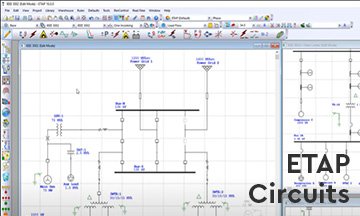
 Register
Book Classes Now

Course Overview
Power system gear must endure not only its rated voltage, which relates to the highest voltage of a particular unit, but also expects short level voltages. One of the key issues related to voltages is the arc flashing study which is based mainly on the studies of short circuit and relay coordination.
ETAP is a type of analysis software for the study of power systems used in many industries. Power systems analysis means verifying the suitability of the power distribution system and its components, recognising coordination related disruptions and outages, and gathering the required data to perform a detailed study.
The purpose of this training course is to learn power system modelling and analysis using ETAP software. In this course, the ETAP software will be looked at in order to assess different power analysis models.
What is the necessity for this “Electrical Transient Analysis Program (ETAP) on Circuits” course? The continuity and quality of electricity to be provided in a safe and economical manner is important for both the developed and the developing economies.
Furthermore, the correct modelling of power system equipment and the correct fault analysis of electrical networks are preconditions to ensure the correct identification of economic network ventures. Environmentally friendly and financial factors require engineers to maximise the use of existing assets, and therefore, the use of accurate modelling and analysis techniques becomes significantly important.
This Zoe training course will empower you with knowledge in a range of ETAP functionalities used to solve practical power system problems such as equipment sizing in steady-state and short circuit conditions, motor acceleration scenarios, protection of the equipment, selectivity, device coordination, and the effects of harmonics on the system.
Course Objectives
Upon completing this Electrical Transient Analysis Program (ETAP) on Circuits course successfully, participants will be able to:
- Grasp the importance of power system modelling
- Comprehend the demand for calculation of short circuit current
- Perform manual calculations of short circuits using simple methods
- Analyse the motor starting/acceleration
- Switchgear breaking and making capacities
- Recognise the importance of arc flashing and relay coordination studies from operation and safety point of view
- Design of S/S grid earthing using ETAP
- Write test cases simulation using computer software (ETAP 11.00)
- Explore the powerful capabilities of ETAP Power Station from OTI
Training Methodology
This collaborative Electrical Transient Analysis Program (ETAP) on Circuits training program will comprise the following training methods:
- Lectures
- Seminars and Presentations
- Group Discussions
- Assignments
- Case Studies and Functional Exercises
Like all our courses, this course also follows the ‘Do-Review-Learn-Apply’ model.
Organisational Benefits
Companies who nominate their employees to participate in this Electrical Transient Analysis Program (ETAP) on Circuits course can benefit in the following ways:
- Keep your company one step ahead with this all-inclusive overview of Electrical Transient Analysis Program (ETAP) on circuits
- Assist technical committees to create, publish and revise working standards relating to the Electrical Transient Analysis Program (ETAP) on circuits
- Carefully study examples and case studies to illustrate the material being discussed and ensure that the material is appropriate to the organisation represented
- Leave with an awareness and understanding of their roles and responsibilities in the workplace in relation to Electrical Transient Analysis Program (ETAP) on circuits
Personal Benefits
Individuals who participate in this Electrical Transient Analysis Program (ETAP) on Circuits course can gain from it in the following ways:
- Keep up with late-breaking developments in the Electrical Transient Analysis Program (ETAP) on circuits by studying new literature and other sources of information
- Benefit from a tailor-made academic program for technicians or equivalent workforce involved in the Electrical Transient Analysis Program (ETAP) on circuits
- Get yourself trained, assessed, and certified by experts in the Electrical Transient Analysis Program (ETAP) on circuits domain
- Provide examples of issues that they encounter during their normal working activities and possible solutions
Who Should Attend?
This Electrical Transient Analysis Program (ETAP) on Circuits course would be suitable for:
- Current users seeking a refresher course
- New ETAP users
- Power engineers who aim to increase their skills using ETAP
Course Outline
MODULE 1: OVERVIEW OF ETAP
- Overview of ETAP Capabilities and Limitations
- One-Line Diagram/One line View (OLV)
- Creating and merging different revisions, presentations, and configuration
- Scenario, Study and Project Wizards
- Crystal Reports and Customisations
MODULE 2: ELEMENTS OF ETAP
- AC and DC Element Descriptions
- Load modelling
- Electrical systems modelling and fundamentals
- Load flow (balanced and unbalanced) analysis
- Load flow and cable sizing
MODULE 3: SIZING & FAULT CALCULATIONS
- Transformer sizing
- Benefits of calculated short circuit currents
- Introduction to fault current calculations in brief
- Breaking and making currents
- Per unit systems
- Different typical values of positive, negative and zero phase sequence impedances
MODULE 4: PERFORM CALCULATIONS USING STANDARD TECHNIQUES
- Manual calculations of Isc by MVA Method
- Calculation of Isc by impedance method
- Calculation of Isc by symmetrical components
- Calculations as defined and recommended by IEC/ANSI standards
- Fault-Levels
- Switchgear/Fuse Rating
- Typical cases for switchgear sizing
- Relay co-ordination and Arc Flashing studies
MODULE 5: DATA COLLECTION, PLOTTING & MODELLING
- Procedures
- Data Collection
- Plotting Time/Current Curves
- Relay Coordination Intervals
- Equipment damage curves for cables, transformers
- System Modelling for Device Coordination Study
- ETAP Star (Device Co-ordination/selectivity)
MODULE 6: EARTHING & ACCELERTION ANALYSIS
- System earthing (solid, resistance and reactance or even ungrounded systems)
- Substation grounding grid design and Calculations
- Motor Parameter Estimation
- Motor Acceleration Analysis (Dynamic and Static)
- Test simulation cases using ETAP
- Course Evaluations and Summary
MODULE 7: INTRODUCTION TO ETAP SOFTWARE
- Introduction to ETAP Software
- A simple guide to creating Single Line Diagrams in ETAP
- How to add templates and add parameters to SLD
MODULE 8: INTRODUCTION TO ETAP SOFTWARE
- Load Flow Analysis
- Report Manager and Transformer Overloading
- Composite Network in ETAP
- Short Circuit Analysis
- Arc Flash Analysis
MODULE 9: INTRODUCTION TO ETAP SOFTWARE
- Motor Acceleration Static Study
- Motor Acceleration Study Dynamic
- Motor Acceleration Study with VFD
MODULE 10: INTRODUCTION TO ETAP SOFTWARE
- Cable Pulling System
- Cable Ampacity Calculation with Underground Raceway System